
If you’re here, you’ve probably been searching for the “fpv drone meaning” and finding yourself a bit overwhelmed. I see you, and I was you. Three years ago, I was in the exact same spot. I’d see these incredible, high-speed videos of pilots diving down buildings and skimming across treetops, and I couldn’t understand how it was possible. I had a “regular” camera drone, one of those stable, GPS-guided ones, and what I was seeing online looked like it was from another planet.
The term “FPV drone” was just a string of letters. I quickly learned that the meaning of fpv drone isn’t just a simple definition.
The core pain point for most newcomers is confusion. The word “drone” is used to describe everything from a $30 toy to a $20,000 cinematic rig. You’re trying to figure out where FPV fits in, what makes it so different, and frankly, why it looks so hard.
In this post, I’m going to pull back the curtain. I’m going to share my 3-year journey and break down exactly what does fpv drone mean—not just as a technical term, but what it feels like to be in the pilot’s seat. We’ll cover the gear, the different styles of flying, and the lingo that sounds like a foreign language right now. My goal is to give you the clear, no-fluff answers I wish I’d had when I started.
Let’s get into it.
What Does FPV Mean in Drones?
At its simplest, FPV stands for First-Person View.
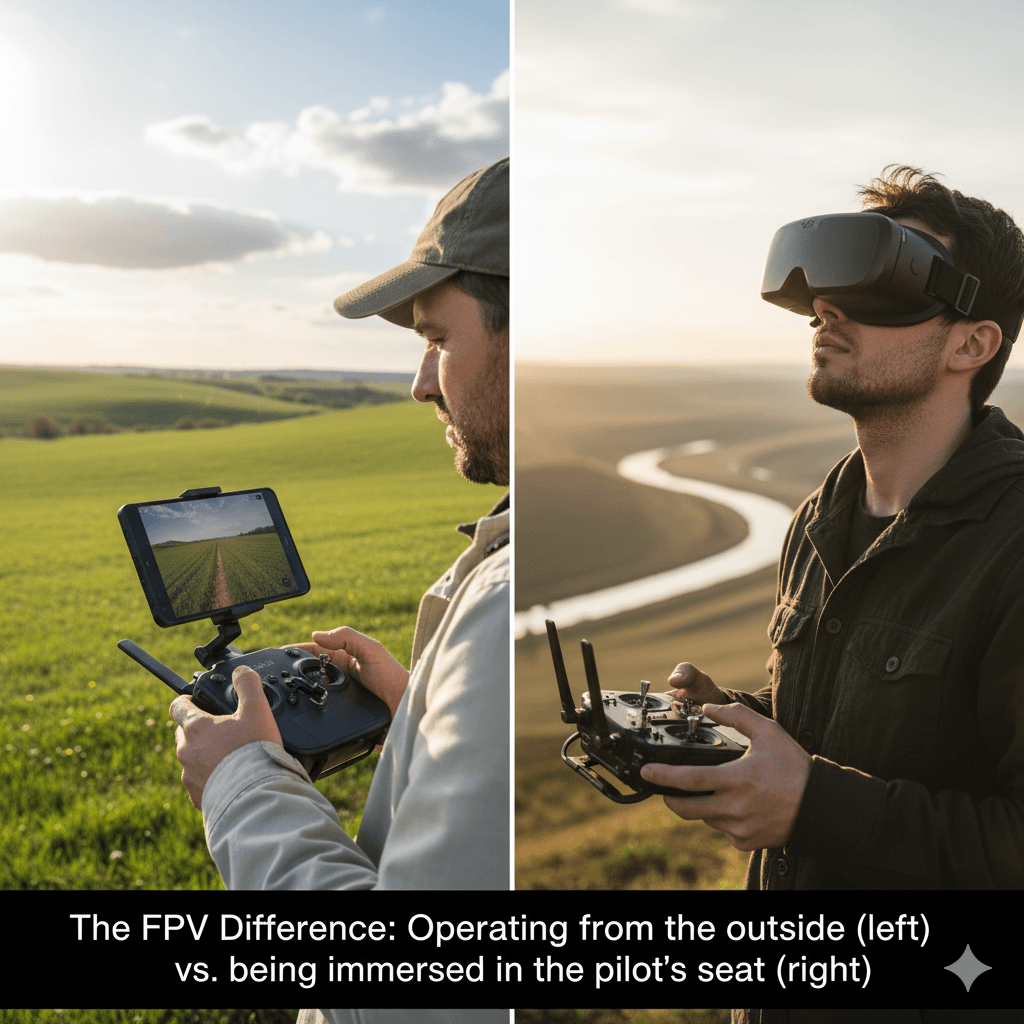
This is the absolute heart of the fpv meaning drone enthusiasts live by. It means that when I fly, I am not standing on the ground looking at my drone. I am wearing a pair of specialized goggles that show me exactly what the drone’s front-facing camera sees, live and in real-time.
The best analogy I have is this: flying a normal camera drone is like playing a video game in the third person. You see your character (the drone) on a screen and you command it from a distance. You are an operator.
The drone fpv meaning is that you are playing in the first person. You are in the cockpit. The drone becomes an extension of your own body.
When I put my goggles on, my physical body is on the ground, but my senses and my mind are hundreds of feet in the air, banking around a tree at 80 mph. The immersion is total. This is the fundamental what does fpv mean in drones distinction, and it changes everything. It’s the difference between operating a tool and mastering a skill.
This immersive experience is precisely what does fpv mean for drones and the pilots who fly them. It’s why we look so locked-in when we fly—we aren’t just watching a screen; we are flying.
It’s Not Just a Drone, It’s a FPV Drone System
When I first started, I thought I could just buy “an FPV drone.” I quickly learned that when someone asks me, “what is fpv drone mean?“, the answer is about an ecosystem of three parts that must work together perfectly. The fpv drone means you have:
- The Drone (or “Quad”)
- The Goggles
- The Controller (or “Radio”)
Let’s break down what what means fpv drone in terms of hardware.
1. The Drone (The “Quad”)
My FPV drones look nothing like the white, foldable ones you see in tech stores. They are raw, purpose-built machines, often built from carbon fiber. Most of the time, I’ve built them myself, soldering every wire.
The key components are:
- The FPV Camera: This is a small, specialized camera at the front. Its only job is to send a low-latency (as close to zero lag as possible) video feed. This is not what I record with.
- The HD Camera: This is the GoPro (or similar) I strap to the top. This records the beautiful, cinematic footage you see online. The FPV camera is for me to fly; the HD camera is for you to watch later.
- The VTX (Video Transmitter): This is the magic box. It takes the signal from my FPV camera and transmits it on a specific radio frequency (usually 5.8GHz) to my goggles.
This VTX is where some of the lingo comes from. A beginner might ask, “fpv drone what does mw mean?” This stands for milliwatts, and it’s the output power of the VTX. More ‘mW’ means a stronger signal, which can mean more range and better penetration through obstacles like trees or concrete. When I started, I just cranked it to the max, but I learned that’s a rookie mistake. It generates immense heat, drains your battery, and can be illegal in many areas without a proper amateur radio license. Now, I match my ‘mW’ to my environment—low for indoors, higher for mountain surfing.
2. The Goggles
This is my cockpit. It’s not just a screen strapped to my face like some cheap “VR” headset. Inside are high-resolution micro-displays and one or more video receivers with specialized antennas. These are designed to catch that 5.8GHz signal from the drone with maximum clarity and minimal lag.
When you see a cheap drone advertising “what does 720p fpv mode mean for a drone“, be very, very cautious. That is almost always referring to a drone that uses WiFi to send a laggy, low-frame-rate video to your phone. My goggles, by contrast, use dedicated radio hardware.
The lag (or latency) is the critical factor. My FPV system—whether it’s older analog or modern digital—has a latency of around 20-30 milliseconds. That’s virtually instantaneous. A WiFi FPV drone can have 100-200ms of lag or more. That’s the difference between dodging a branch and being stuck in a tree.
3. The Controller (The “Radio”)
This is my connection to the drone. It’s not a toy. It’s a sophisticated “hobby-grade” transmitter. The gimbals (the sticks) are high-precision. It runs on a high-speed, long-range control link (not WiFi or Bluetooth) that is robust and reliable.
This radio is what allows me to fly in “Acro Mode,” which is the true heart of FPV flight. And that brings us to the biggest difference of all.
Why Are FPV Drones Special
I get this question at the park all the time. “I have a drone, what’s so different about yours?”
My answer is always the same: “It’s like comparing a family sedan with automatic transmission to a full-manual, track-prepped sports car.”
Both are “cars,” but their purpose and the skill required to operate them are fundamentally different.
The Flight Mode: “Acro” is Everything
This is the most important concept in the fpv drones meaning.
Your typical camera drone flies in a “stabilized” mode. It uses GPS, barometers, and bottom-facing sensors to hover perfectly in place. If you let go of the sticks, it just stops and waits for your next command. It’s designed to be an easy, stable camera platform.
My FPV drones are flown exclusively in “Acro Mode” (short for Acrobatic).
In Acro Mode, all of that self-leveling stabilization is off.
- If I push the stick forward to tilt the drone, and then let the stick go… the drone stays tilted forward and continues accelerating.
- It does not return to level. It does only and exactly what I tell it to.
This is what allows for the flips, rolls, inverted flight, and graceful, coordinated turns you see in freestyle videos. It’s 100% manual control.
I will never forget my first time trying Acro. I had practiced on a simulator (which I implore you to do), but my first real-life battery was a disaster. I took off, wobbled, panicked, and promptly disarmed into the grass from five feet up. It’s a steep, steep learning curve. But once it “clicks,” the feeling of control is absolute. This is what does fpv when drone mean—it means true, unassisted flight.
Durability & The “Right to Repair”
I crash. A lot. Three years in, I still crash. Every FPV pilot crashes. It’s part of the progression.
These drones are designed for it.
- The frames are thick-cut carbon fiber.
- The electronics are separate, modular components.
- There are no delicate GPS masts or dangling gimbal cameras (the GoPro is tough, but the FPV camera is protected inside the frame).
If I slam into a concrete pillar and break an arm (which I did two weeks ago), it’s not a $500 repair bill. I go home, get my soldering iron, unscrew the broken arm, solder the three motor wires for the new arm, and I’m back in the air in 20 minutes. The total cost? About $15 for the new arm.
This build-it-fly-it-crash-it-fix-it cycle is a core part of the hobby and the fpv drone mean culture. We are tinkerers and builders, not just consumers.
The Many Faces of FPV
So, you know what does FPV mean on a drone technically. But what do people do with it? When I started, I thought it was all about racing. I quickly learned FPV is a gateway to many different passions.
1. Freestyle
This is my personal passion and what I spend 90% of my time doing. This is the “skateboarding” of the FPV world. We find a location—an abandoned building (we call them “bandos”), a beautiful mountain ridge, an open park—and we use it as our canvas.
The goal is a fluid, expressive combination of acrobatic tricks (flips, rolls, power-loops) and smooth, flowing lines. It’s an art form. We are chasing “the perfect line,” and it’s a creative expression that is deeply personal.
2. FPV Drone Racing
This is where FPV as a hobby exploded from. The fpv drone racing meaning is simple: pure, unadulterated speed. Pilots build incredibly light, powerful, and aerodynamic drones to navigate a complex, three-dimensional course marked by illuminated gates and flags.
This is a true high-speed sport, requiring millisecond reflexes and intense practice. When a fellow pilot asks me “fpv race drone what does fpv mean?”, my answer is “competition.”
This is also where some of the size classifications come from. You might hear someone ask, “what does the 250 mean in fpv drone racing?” Historically, this referred to the frame size—250mm measured diagonally from motor to motor. This was a very common racing class size in the early days. While the classes and rules have evolved, the what does the 250 mean in fpv drone question is a direct descendant of this racing history. It’s just a way to classify the drone’s size and power.
3. Cinematic FPV & “Cinewhoops”
This is a newer, massive part of the FPV world and is now a legitimate professional career for many pilots. A “Cinewhoop” is a specific type of FPV drone—small, stable, and with its propellers in protective ducts.
These are not for high-speed acrobatics. They are designed to carry a high-quality camera (like a GoPro) to get smooth, slow, and dynamic shots impossibly close to subjects. Think of those videos flying through a car window, around a house in one continuous take, or diving down a waterfall. That’s cinematic FPV. It’s all about capturing that “impossible shot” that a large, stable camera drone could never get.
4. Long Range & Exploration
Some of us are explorers at heart. We build specialized FPV drones with high-efficiency motors, large batteries, and GPS return-to-home features (just in case!). The goal is to “mountain surf,” flying miles out to crest a peak you’ve never climbed, or to explore a remote coastline. The feeling of seeing a view from miles away, all through the immersion of your goggles, is something I can’t even describe.
Okay, let’s clear up some of those other confusing terms you’ve probably seen. The fpv drone meaning comes with its own language, and I was completely lost at first.
FAQ
“What does 2S or 6S mean?”
This was the most confusing thing for me as a beginner. When I ask or see the question “fpv drone what does 2s or 6s mean“, the answer is all about the battery.
- “S” stands for “Series” and refers to the number of battery cells connected in series.
- A 1S battery has 1 cell (about 3.7 volts).
- A 2S battery has 2 cells (about 7.4 volts).
- A 6S battery has 6 cells (about 22.2 volts).
More cells = more voltage = dramatically more power and “punch.”
My 5-inch freestyle drones all run on 6S batteries. They are absolute rockets. My tiny indoor drones (we call them “Tiny Whoops”) run on 1S. My 3-inch “toothpick” drone runs on 2S or 3S. It’s all about matching the battery voltage to your motors for a specific size and purpose. I once plugged a 6S battery into a drone built for 4S. The “pop” and puff of magic smoke taught me that expensive lesson very quickly.
“What does WiFi FPV drone mean?”
You will see this everywhere on cheap, toy-grade drones. Please, as a new pilot, be careful here. This is not the same hobby.
So, what does wifi fpv drone mean? It means the drone uses your phone’s built-in WiFi to send a video signal to an app.
The problems are massive:
- Extreme Lag (Latency): WiFi was never designed for this. The video feed is often delayed by half a second or more.
- Short Range: You’ll be lucky to get 100 feet before the signal drops.
- Interference: It’s easily disrupted by other WiFi networks.
It’s physically impossible to fly with the precision and speed of true FPV using a WiFi link. It’s a frustrating toy, not a performance tool. True FPV, as I’ve been describing, uses a dedicated, low-latency analog or digital video link on 5.8GHz.
“So… What does FPV mean in flying a drone?”
To bring it all home, what does fpv mean in flying a drone for me, three years into this?
It means freedom. It means a “flow state” where, for a few minutes, the world and all its noise melts away, and my only focus is the gap in the trees ahead. What does drone fpv mean? It means a global community of builders, tinkerers, artists, and engineers who are all chasing that same feeling.
The fpv drone what does it mean? It means a challenge, a thrill, and an art form, all rolled into one.
My Advice for Your First Steps
If this article has lit a fire in you, your next question is “How do I start?”
Please, learn from my early, expensive mistakes. Do not go out and buy a $500, 100 mph 6S drone. You will destroy it in ten seconds.
This is my 3-year-experience advice, the path that will save you hundreds of dollars and countless hours of frustration.
- Step 1: Buy a Real Controller FIRST. Buy a proper, hobby-grade FPV controller (a “radio”) like a Radiomaster Zorro or Boxer. This will be the one piece of gear that stays with you for years.
- Step 2: Fly on a Simulator. Plug that controller into your computer and buy an FPV simulator like VelociDrone or Liftoff. Practice for at least 20 hours. This is not a suggestion; it’s a requirement. This is where you will build the muscle memory for Acro Mode. This is where you will crash 1,000 times for free.
- Step 3: Buy a “Whoop” or a Starter Kit. Your first real drone should be a small, durable “Tiny Whoop” for flying indoors or a pre-built “Bind-and-Fly” (BNF) kit. These kits often come with a beginner-friendly drone, a set of goggles, and a controller, all designed to work together right out of the box.
This path lets you learn the real skill of FPV flight before you invest in (and risk) expensive gear.
Conclusion
So, the fpv drone meaning isn’t just a technical acronym. It’s a portal.
It’s the closest I have ever come to the human dream of flight. It’s a hobby with a steep learning curve, a deep technical rabbit hole, and a community that is incredibly passionate and helpful.
Three years in, I’m still learning every single day. I’m still pushing my limits, still repairing my quads on my workbench, and still getting that jolt of adrenaline every time I punch the throttle. The meaning of fpv drone is whatever you want it to be—a sport, an art, an exploration tool.
For me, it’s freedom. And the view from up there… it changes everything.